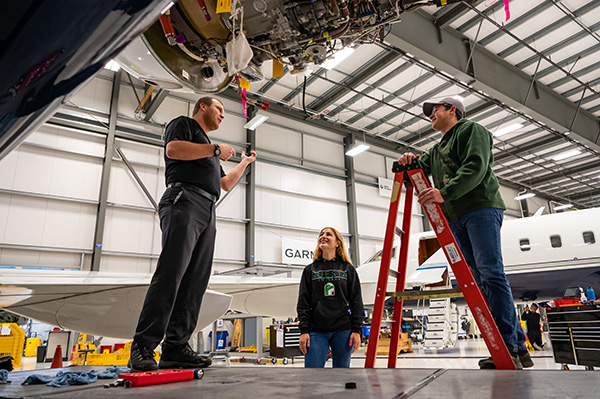
FAA Airframe and Powerplant Certification
The FAA requirements for eligibility for an aircraft mechanic certificate include the following:
- At least 18 years old
- Able to read, speak, and understand English
- Meet the experience or educational requirement
Once these criteria are met, a series of exams are completed to confirm the level of your knowledge.
These tests are divided into 3 sections: General, Powerplant, and Airframe.
In each of these sections, there is an oral, practical, and written examination. Upon completion of the two-year program, you will be qualified and prepared to complete exams in all three sections.
Program Length and Schedule
The Aviation Maintenance Technology program is a two-year program delivered in cohort style, with new cohorts starting each Spring semester.
- Even years — Night Cohort: Monday through Friday, 4:30 p.m. – approximately 10 p.m.
- Odd years — Day Cohort: Monday through Friday, 8 a.m. – approximately 3 p.m.
The program is demanding and full-time in scope; students should plan their work and personal commitments around the cohort schedule.
Locations
San Luis Obispo Airport Classroom
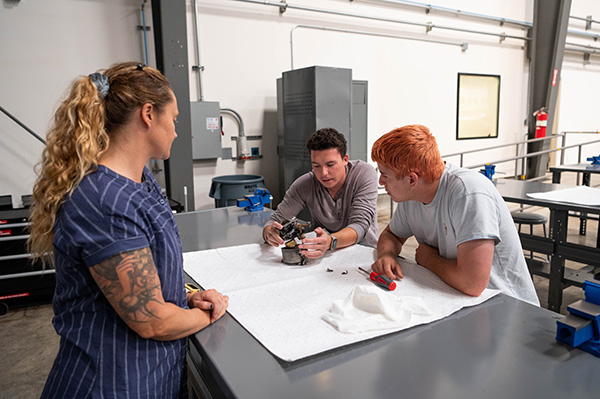
Cuesta College's Aviation Maintenance Training facility at the San Luis Obispo County Regional Airport. Training includes hands-on work
Student Costs
Tuition
- $46 x 48 Units = $2,208 Tuition ($552 per semester)
- Books & Supplies = $500 Estimated*
*We are currently providing tools; student may want to purchase their own, not required
FAA Testing: $2,400 - $3,125
- FAA Written Exam: $175 x 3 = $525
- Practical Exam $800 - $1200 = 2 (Airframe & Powerplant) $1600 - $2400
More Financial Aid & Fee Information
- Cost of Attendance: Full tuition and fees, plus cost of living estimates
- Significant financial aid is available for qualified students. Detailed information can be found on the Financial Aid website.
FAA Testing Process
Cuesta College's Aviation Maintenance Technology program is an FAA-recognized Part 147 Aviation Maintenance Technician School. Because of this recognition, your graduation certificate from Cuesta serves as your official FAA eligibility document to sit for the FAA Airframe & Powerplant (A&P) certification exams — replacing the FAA Form 8610-2 that other applicants must obtain through documented work experience.
Important: Graduating from Cuesta's program does not automatically confer FAA mechanic certification. It authorizes you to take the FAA tests. To earn your A&P certificate, you must pass three separate FAA exams — General, Airframe, and Powerplant — each consisting of three parts:
- Written (Knowledge) Test — administered online at an FAA-approved testing center (PSI) using the Aviation Mechanic Airman Certification Standards (ACS).
- Oral Test — administered by an FAA-authorized Designated Mechanic Examiner (DME).
- Practical Test — hands-on projects administered by the same DME, using the Mechanic Test Generator (MTG) to randomly select tasks from the ACS.
A Designated Mechanic Examiner is a private-industry expert authorized by the FAA to conduct oral and practical mechanic testing on the agency's behalf. The DME conducts a pretest interview (in person, by phone, or by video), reviews your eligibility documents (including your Cuesta graduation certificate), and administers the oral and practical exams at their own testing facility. Once you pass, the DME can issue your temporary airman certificate on the spot.
All FAA testing fees are paid directly to the FAA testing center (for written exams) and to the DME (for oral and practical exams) — they are not paid to Cuesta College. See the estimated costs in the Student Costs section above.
Learn more about FAA mechanic testing requirements »

Curriculum
The Aviation Maintenance Technology (AVMT) program provides training in everything from changing a tire to rebuilding a turbine engine to taxiing the aircraft.
Hands-On Training
Traditional education can be frustrating and even alienating for those who learn by doing. This program is different. We value hands-on learning and career training. Our instructors have worked as certified mechanics and are ready to treat the classroom like an aircraft hangar – because it is!
- Aircraft engine change, inspection, review, and testing.
- Techniques of sheet metal repair using proper tools, parts layout, forming and bending aluminum materials, and composite repair.
- Service, troubleshoot, and repair hydraulic and pneumatic systems and components.
- Welding inspection, assembly and rigging of aircraft controls, aerodynamics, aircraft fuel systems, and aircraft fire protection.
Course Sequence Starting Spring 2024
Course Sequence (Two-Year Program, Starting Each Spring)
Year 1 — Spring Semester
- AVMT 110 – General I
- AVMT 120 – General II (FAA General Written Exam)
Year 1 — Fall Semester
- AVMT 130 – Airframe I
- AVMT 140 – Airframe II
Year 2 — Spring Semester
- AVMT 150 – Airframe III (FAA Airframe Written, Oral & Practical)
- AVMT 160 – Powerplant I
Year 2 — Fall Semester
- AVMT 170 – Powerplant II
- AVMT 180 – Powerplant III (FAA Powerplant Written, Oral & Practical)